
Hi you.
I want to talk about something that I think many new mothers feel… but far fewer talk about openly. It’s this quiet, unsettling feeling of looking at your life after baby and thinking: “Why don’t I feel like myself anymore?”
Or maybe it sounds more like: “I love my baby, so why do I miss my old life so much?” “What’s wrong with me?” “Why does this feel so much harder than I thought it would?”
If this is you, I want you to know something right away:
You are not broken.
You are not a bad mother.
And you are definitely not alone.
As a therapist who works with women during pregnancy and postpartum, I hear some version of this all the time.
Many of the mothers I work with are intelligent, capable, thoughtful women. They are planners. Helpers. High achievers. They’re used to functioning at a high level. Many are self-described perfectionists or “Type-A.” They’ve read the books. Taken the classes. Bought the gear. Prepared for birth and parenting in every way they knew how.
And yet, after baby arrives, many are caught off guard by just how emotionally complex this transition can be. Not because they don’t love their baby. But because the postpartum period is not just physical recovery... it’s also a massive identity shift.
The Loss of Identity After Baby Is Real
Let’s talk about something that deserves way more attention: loss of identity after becoming a parent.
Most people expect the sleep deprivation. Fewer people expect to feel like they barely recognize themselves.
You may find yourself:
- Missing your independence or spontaneity
- Feeling disconnected from hobbies, work, or friendships
- Feeling less confident than you used to
- Wondering, Who even am I now?
Sometimes mothers tell me, “But nothing is even that wrong. I have a healthy baby. My partner helps. So why do I feel this way?” That question alone often carries so much shame.
Here’s what I want to say: Just because something is wanted, beautiful, or meaningful does not mean it isn’t also hard. Those things can coexist.
Even Good Changes Can Bring Grief
This is something I wish more people understood. Grief is not only about death or tragedy. Grief can also happen anytime life changes in irreversible ways. Yes, even after having a baby.
Sometimes postpartum grief looks like missing:
- Privacy
- Quiet
- Freedom
- Spontaneity
- Your previous routines
- Ease in your relationship
Before baby, leaving the house may have meant grabbing your keys and walking out the door. After baby? Leaving the house can feel like a military operation!
Feed the baby.
Change the diaper.
Pack the diaper bag.
Did you bring bottles?
Pacifier?
Burp cloth?
Extra outfit?
Will they need to eat while you’re gone?
What if they cry the whole time?
You get the idea.
Suddenly, your time doesn’t feel like your own. That is a real loss. And acknowledging that loss doesn’t make you ungrateful. It makes you honest.
Why Postpartum Can Feel So Overwhelming
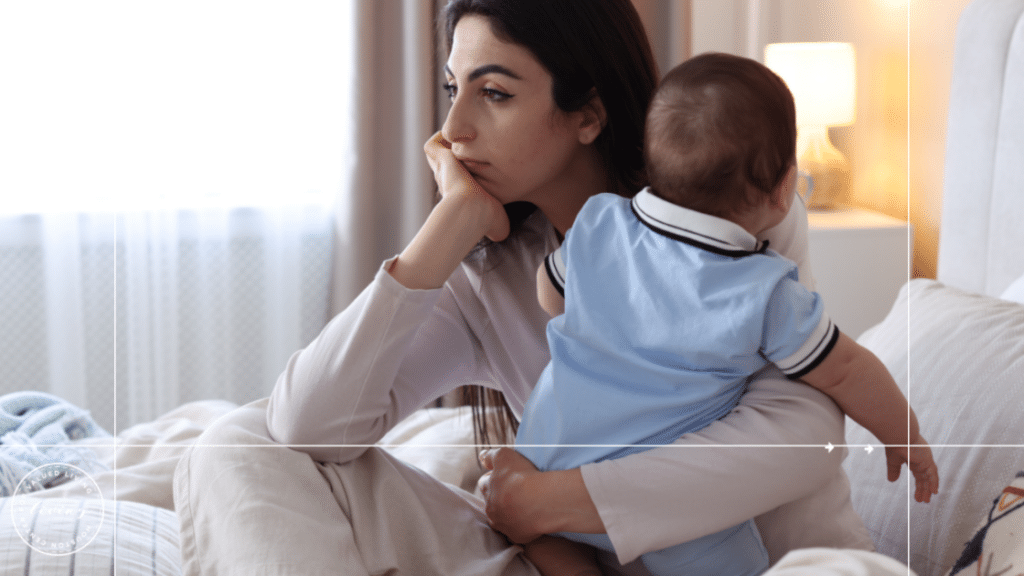
One thing I often help moms understand is something called role strain. Role strain happens when the demands placed on you exceed your available time, energy, or support. And after having a baby? That happens a lot.
You may suddenly be juggling multiple roles at once:
- Parent
- Partner
- Employee or student
- Caregiver
- Household manager
- Daughter, friend, sibling, helper
Each role comes with expectations. Some are external. Many are internal.
And often those internal expectations sound something like:
I should be able to handle this.
Other moms seem to do this just fine.
Why am I struggling so much?
Why can’t I keep up?
Sound familiar?
This pressure to “do it all” is exhausting. And when you add sleep deprivation on top of it? Things can spiral quickly.
When It Might Be More Than Normal Adjustment
I want to pause here and make an important distinction. Not all postpartum overwhelm means you have a mental health disorder. Sometimes what you’re experiencing is a very real adjustment to enormous life change. But sometimes persistent distress may point to something more - like Postpartum Depression or Postpartum Anxiety.
Symptoms of postpartum depression may include:
- Persistent sadness
- Crying often
- Loss of interest or pleasure
- Hopelessness
- Feeling numb or disconnected
- Excessive guilt or shame
- Thinking your baby or family would be better off without you
Symptoms of postpartum anxiety often look different. In fact, many moms with postpartum anxiety don’t describe themselves as “anxious” at first. They describe themselves as constantly thinking. Constantly scanning. Constantly anticipating problems. Constantly worrying.
It sounds like:
What if something happens while the baby is sleeping?
What if I miss something important?
What if I’m doing this wrong?
They can’t turn their brain off. Even when the baby sleeps, they may not be able to. That’s one reason postpartum anxiety can feel so exhausting.
So What Actually Helps?
First, let’s start here:
Validate your experience
Your feelings make sense. Read that again. Your feelings make sense. When we stop fighting our feelings or shaming ourselves for having them, we create more space to respond with compassion instead of criticism.
Embrace two truths
This is one of my favorite concepts for new parents. Two things can be true at once. You can be grateful for your baby and miss your old life. You can love motherhood and struggle with parts of it. You can feel joy and grief. Making room for both reduces guilt.
Challenge all-or-nothing thinking
Perfectionism loves extremes. You’re either doing great… or failing. You’re either enjoying motherhood… or something must be wrong. But real life is messier than that. Most growth happens in the middle.
Reconnect with yourself
What parts of you existed before motherhood that helped you feel like yourself?
Maybe it was:
- Exercise
- Gardening
- Reading
- Time outdoors
- Coffee with friends
- Quiet mornings
- Creative hobbies
Those needs do not magically disappear because you had a baby. In fact, stressful seasons often make those needs more important, not less. Start small. I mean really small. Five minutes outside. Ten minutes reading. A short walk alone. Small changes count.
Redefine productivity
This one is big.
Many women continue judging themselves by pre-baby standards. But productivity may need to be redefined in this season. Feeding your baby is productive. Resting is productive. Recovering is productive. Bonding is productive. Not every meaningful thing produces a visible result.
Build support
Humans were never meant to parent in isolation. And yet modern parenthood can feel incredibly lonely. Please don’t underestimate the power of support. Talk to trusted people. Let them help. Ask directly when possible. And if things feel persistently heavy, consider professional support. Therapy can help you process the grief, anxiety, perfectionism, and identity changes that often accompany early parenthood.
You Are Not Going Back (And That’s Not a Bad Thing)
I want to leave you with this.
So many mothers tell me: “I just want to feel like myself again.” I understand that longing. But what if the goal isn’t actually to go backward? What if the goal isn’t getting back to the exact version of you that existed before baby? Because the truth is you have changed. And change isn’t always loss. Sometimes it’s expansion. Redefining who you are after baby isn’t about erasing motherhood or erasing your old self. It’s about integration. Holding onto the parts of yourself that still matter… while making space for the new parts that are emerging. That takes time and patients, and it often takes support. So if you don’t fully feel like yourself right now, I want you to hear this: You may not be lost. You may simply be in the middle of becoming.
Reflection Questions
- What parts of my old self do I miss most?
- What still feels like me?
- What new parts of myself do I want to nurture?
- What matters most in this season?
If you are struggling with postpartum depression, postpartum anxiety, or feeling overwhelmed after baby, please know support is available. You do not have to navigate this alone.
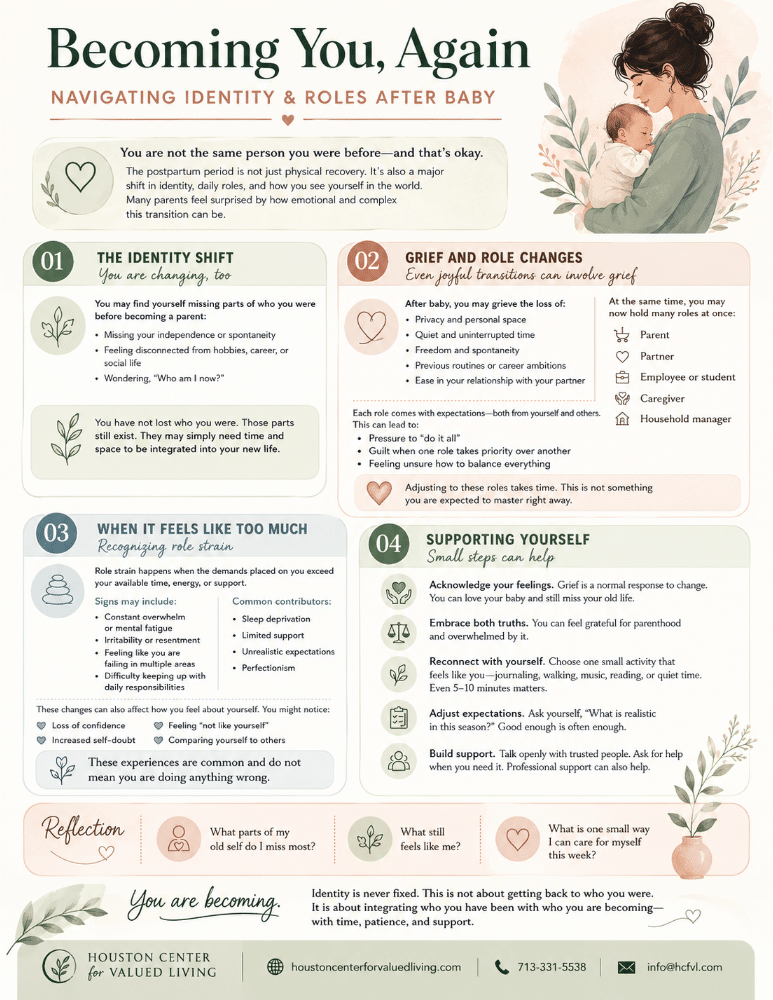
Below you can download my Becoming You, Again printable handout.

Kathryn Tipton, MA, LPC, PMH-C, is a licensed therapist and co-founder of The Houston Center for Valued Living. She specializes in reproductive mental health and insomnia, helping clients navigate life’s hardest moments with clarity, compassion, and evidence-based tools. She hosts a no-cost virtual postpartum support group with the mission to decrease isolation in the early days of motherhood.