
If you’ve ever found yourself snapping at your partner, feeling your chest get hot, or needing to walk away because your anger feels like it might spill over, you are not alone.
This is something I hear about often from the moms I work with, and it’s one of the most surprising and confusing parts of the postpartum experience for many people.
When we think about postpartum mental health, we tend to expect sadness or anxiety. What doesn’t get talked about enough is anger.
Irritability. Snapping. Feeling like your reactions are bigger or faster than you expected.
Many parents describe this as postpartum rage.
What Is Postpartum Rage?
“Postpartum rage” is not a formal diagnosis, but it is a term many parents use to describe intense anger that can show up after having a baby.
It can happen alongside postpartum depression or anxiety, or sometimes on its own.
And from a clinical perspective, it makes sense.
After birth, your body and nervous system are going through a massive adjustment. Hormonal shifts, sleep deprivation, emotional stress, and the constant demands of caring for a baby all add up.
When your system is stretched thin, it becomes more reactive. Anger can be one of the ways that overload shows up.
What Does Postpartum Rage Look Like?
Postpartum rage does not look the same for everyone, but there are some common patterns I hear from clients:
- Sudden, intense anger that feels bigger than the situation
- Snapping or yelling at a partner or older children
- Feeling like you are losing control in the moment
- Wanting to throw things or slam doors
- Feeling hot, shaky, or like your “blood is boiling”
- Guilt or shame right after
- Thoughts like “What’s wrong with me?” or “I’m a bad parent”
Many moms will tell me, “I have never felt anger like this before.”
“Why Am I So Angry?”
This question usually comes with a lot of shame.
But when we slow things down, the anger starts to make a lot more sense.
Postpartum rage is often connected to being physically and emotionally maxed out. Some of the most common contributing factors I see include:
- Hormonal changes after birth
- Ongoing sleep deprivation
- Lack of consistent support
- Feeling alone in the mental load of parenting
- Relationship strain
- Identity shifts and the loss of your previous routine or sense of self
- Feeling invisible or unacknowledged
- Sensory overload from constant noise, touch, and stimulation
There is also research suggesting that things like financial stress, number of children, and challenges with infant sleep can increase the intensity of anger.
What Is Going On Beneath the Anger?
In many cases, this kind of anger is closely tied to anxiety and an overwhelmed nervous system.
I often explain it to clients this way: your system is on high alert and running on very little fuel.
You might notice things like:
- Feeling constantly on edge
- Having intrusive or unwanted thoughts
- Reacting more quickly to stress or feeling easily overstimulated
And then it shows up in very real, everyday moments:
- It is the third night in a row of broken sleep and the baby starts crying again
- You finally sit down and someone needs something from you
- You feel like you are carrying everything and no one else quite sees it
- Your partner responds in a way that feels dismissive or not helpful
In those moments, the reaction can feel immediate and intense.
That does not mean something is wrong with you. It means your system is overwhelmed.
You Are Not the Only One
One of the hardest parts of postpartum rage is how isolating it can feel.
A lot of moms tell me they feel embarrassed or afraid to talk about it. There is often a layer of guilt, especially if they are not feeling the immediate bond they expected.
I hear things like:
“I did not know I was capable of that kind of anger.”
“I felt so guilty after. I kept thinking, what kind of mom feels this way?”
“I wish someone had told me this could happen.”
If any of that sounds familiar, you are not alone in this experience.
What Can Help in the Moment
When the anger starts to build, the goal is not to make it disappear.
The goal is to create just enough space so you can stay grounded and keep everyone safe.
Some things that can help:
- Pause and take a few slow breaths
- Put your baby in a safe place, like a crib, and step away for a few minutes
- Eat something or drink water if you have not in a while
- Ask for help, even if it feels hard to do
- Reduce stimulation for a few minutes when possible
I say this often to clients, and it is worth repeating here: it is okay to step away briefly if your baby is in a safe place. That pause can make a real difference.
When to Reach Out for Support
Even though postpartum rage is common, it is not something you have to manage on your own.
It may be a good idea to reach out to a therapist or healthcare provider if:
- The anger feels frequent or hard to control
- It is impacting your relationships
- You feel stuck in guilt or shame
- You are having thoughts of harming yourself or your baby
Reaching out for support does not mean you are failing. It usually means you are paying attention to what you need.
For some moms, therapy is enough to help things feel more manageable. For others, medication can also be an important part of treatment. This is something you can talk through with your provider to figure out what feels like the right fit for you.
This is a season where support really matters.
A Final Thought
If you are experiencing postpartum rage, it does not mean you are a bad mom.
More often, it means you are exhausted, overstimulated, and trying to hold a lot with not enough support.
That is something that deserves care and attention, not judgment.
If this is something you are going through, it can get easier with the right support in place. And you do not have to figure it out on your own.
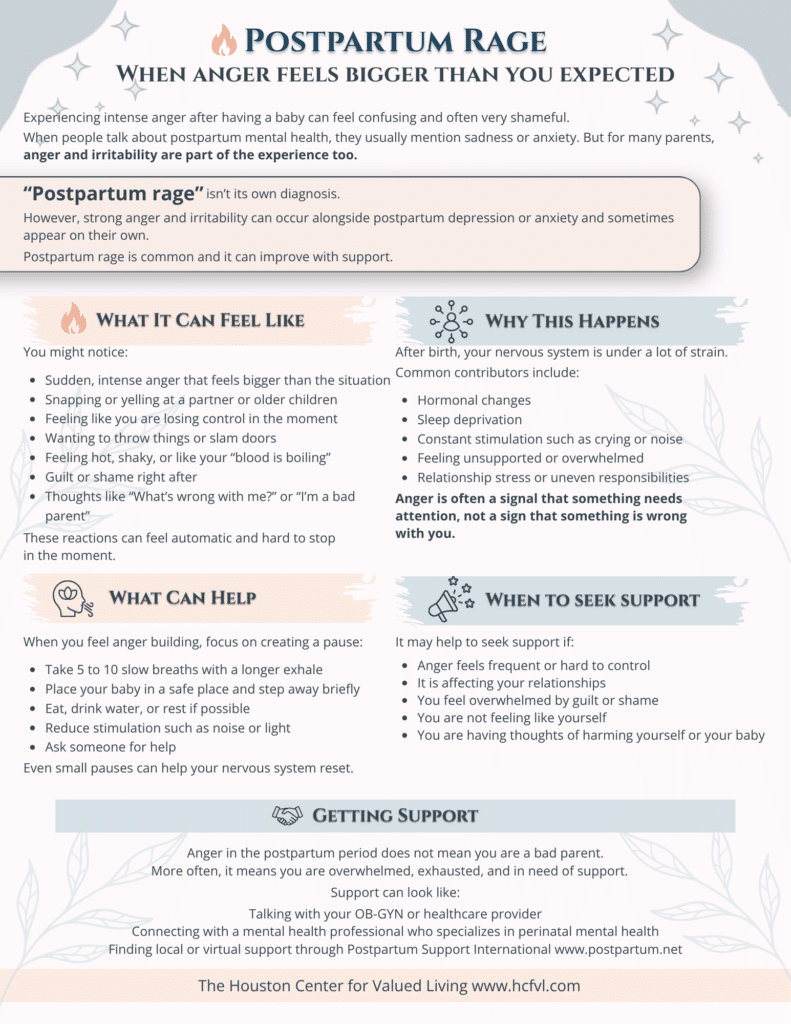
Download a PDF copy of the image below.

Kathryn Tipton, MA, LPC, PMH-C, is a licensed therapist and co-founder of The Houston Center for Valued Living. She specializes in reproductive mental health, insomnia, and anxiety treatment, helping clients navigate life’s hardest moments with clarity, compassion, and evidence-based tools.